Liouville’s theorem states that every function f:C→C which is analytic everywhere and bounded is constant. I recently stumbled across the paper A Note on Liouville’s Theorem (A. Lenard, 1986), that proves Liouville’s theorem using only algebraic power series manipulation: no analysis techniques were used at all, no limits, derivatives, integrals involved. I was shocked this was even possible, but I couldn’t understand the paper. It took me a couple of (very discontinuous) days of work to grasp the cleverness of the proof; it’s really cool and I don’t want to put this understanding to waste, so here’s my attempt to present it in a more intuitive way with more details.
The proof
Our version of Liouville’s Theorem is as follows:
Theorem. If
f(z)=n≥0∑anzn;an∈C
is a power series that converges everywhere in C, and there exists M>0 such that
∀z∈C,∣f(z)∣≤M,
then ∀n∈N∖{0},an=0. That is, f is constant.
Proof. For this proof, we want to show that an=0 for all n≥1 (so f(z)=a0 is only the constant term). We will achieve this by using f to construct a specific absolute sum, which we will then bound to show that f must be constant.
Since f converges everywhere on C, it is also absolutely convergent on C. Hence for any positive r>0 we have
S(r):=n≥0∑∣an∣rn<∞.
Since the absolute sum S(r) converges, if we take a tail of the sum starting at m, it must eventually tend towards 0 as m→∞:
m→∞limn≥m∑∣an∣rn=0.
In particular we can definitely pick some tail of the sequence that has value ≤1/S(r). Let k=k(r) be the smallest positive integer which satisfies that criterion, so it is the smallest positive integer such that
S(r)⋅(n≥k∑∣an∣rn)≤1.
Let ω=exp(2πi/k) be the k-th primitive root of unity. We know that1
k1j=0∑k−1ω(n−m)j={10if n≡m(modk)otherwise.
Remember this for later.
Let F(r) be the arithmetic mean of ∣f∣2=ff at each r⋅ωj, where j runs from 0 to k−1. In other words,
F(r):=k1j=0∑k−1f(r⋅ωj)2.
Since F(r) is the average over some z-values of ∣f(z)∣2, and ∣f(z)∣2≤M2 by assumption, we know F(r)≤M2.
We can obtain a power series form for the mean F(r):
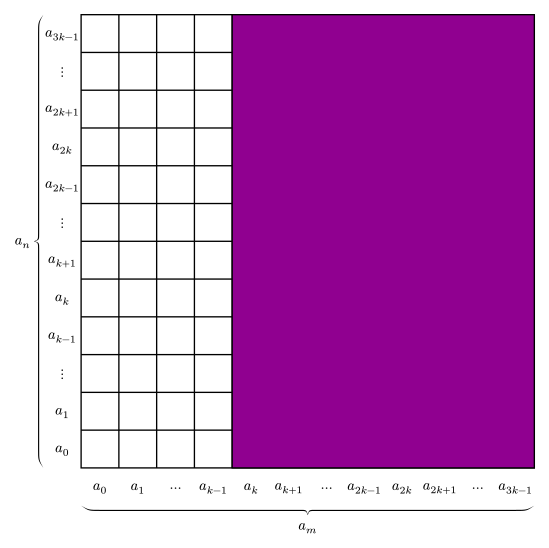
If we consider all choices n,m∈N∪{0} of the term anamrn+m, then the mean F(r) sums up the terms corresponding to something like the black tiles in the following image:
We can break F(r) up into two pieces: the diagonal where n=m, and the parts where n=m. That is, if we define the diagonal
A(r):=n≥0∑∣an∣2r2n,
we can write F(r)=A(r)+G(r), where G(r) represents the off-diagonal elements:
G(r):=n≡m(modk)n=mn≥0∑m≥0∑anamrn+m.
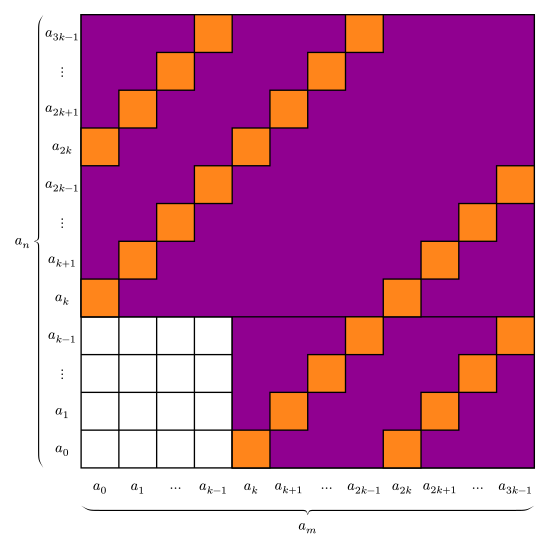
This corresponds to the following image, where the diagonal A(r) sums up the tiles in blue, and the off-diagonal G(r) sums up the tiles in orange.
If we get a bound on the diagonal A(r), then we can get a bound on ∣an∣.
Recall the definition of k=k(r) again: it is the smallest positive integer such that
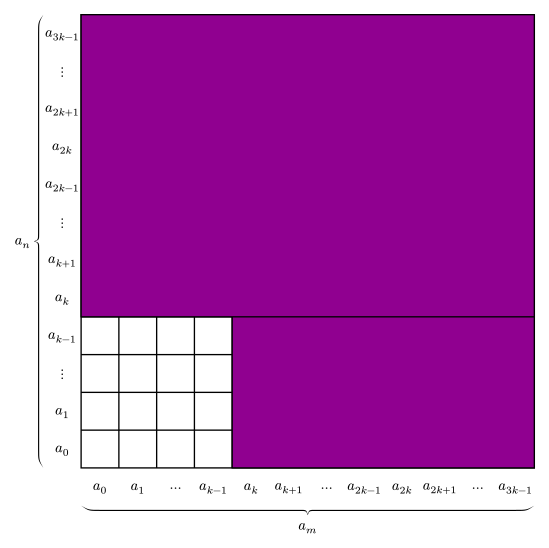
The sum on the RHS of the above equation corresponds to the tiles in purple.
Since ∣an∣∣am∣=∣am∣∣an∣, we can notice that the above table can be mirrored around the line n=m. We can then notice that if we add together two copies of the RHS, like 2∑n≥0∑m≥k∣an∣∣am∣rn+m, then it can be depicted as covering the following tiles (some of them twice):
The algebraic way to see the above table is with two mirrored copies of the sum:
Notice that G(r), consisting of the off-diagonal elements (depicted in orange), is completely covered by the above!
So, if we bound each term in the off-diagonal sum G(r) by its absolute value, it must be bounded above by the absolute sum corresponding to the purple tiles! Formally:
This implies the diagonal term A(r)=F(r)−G(r) must be bounded above:
A(r)=∣A(r)∣=∣F(r)−G(r)∣≤∣F(r)∣+∣G(r)∣≤M2+2.
This also means that A(r) also converges for all r>0 (since every term in the series is positive and it’s bounded above.)
From here it’s trivial. Suppose for contradiction that some aq=0, q≥1. If we then pick
r=1+2q∣aq∣2M2+2,
then we violate the inequality we just proved,
A(r)=n≥0∑∣an∣2r2n≥∣aq∣2r2q>M2+2,
contradiction. □
Okay, wait, what?
When I first saw this proof I didn’t understand it at all. Even after understanding it and writing it up I still don’t really grasp it on a fundamental level. Here are some remarks that may or may not aid in this regard.
In the original paper, Lenard remarks that the definition of F(r) as
F(r):=k1j=0∑k−1∣f(r⋅ωj)∣2
is just a Riemann sum of the integral
2π1∫02π∣f(r⋅eit)∣2dt.
In fact, if you expand out ∣f(reit)∣2=f(reit)f(reit) in the above integral and compute the power series of the resulting function in r, it in fact equals our diagonal A(r):
So another way to see the sum of the off-diagonal elements, G(r), is as the error between a Riemann sum and an actual integral. Our choice of k is just large enough to make sure that the Riemann sum is close enough to make the proof work. (Another way to see that the sum F(r) converges to the diagonal is to note that as k→∞, n≡m(modk) basically just means n=m.)
You can see this if you try to follow the failure of the proof when you take out the assumption that ∣f(z)∣≤M. The entire proof goes through up to and including proving ∣G(r)∣≤2, but the bound fails for A(r). This makes sense: A(r) is the actually important quantity.
The expression A(r)=∑∣an∣2r2n reminds me of Parseval’s identity, but I have no idea what the connection is (or if there even is one).
The fact that a proof even exists that purely uses power series methods makes one wonder whether or not Liouville’s theorem can be generalized beyond C in some manner. According to this math.stackexchange post, there is apparently a corresponding result to Liouville’s theorem over every algebraically closed normed field. (Does this mean there exists a purely power-series proof like the above that doesn’t use complex-number-specific constructions like the complex conjugate? That would be really cool, but is left as an exercise to the reader, because I have no idea.)
You may have seen this before in the more general setting of series multisection. The intuition is that if n≡m(modk), then exponentiating each ωj by n−m just evenly spreads them out around the unit circle, so they add to 0. If on the other hand n≡m(modk), then we are exponentiating each ωj by a multiple of k, so each of them lands 1 and the total sum of all the roots of unity is k, which we multiply out by 1/k to get the result. ↩
.DLIo_oaU_Z17LrUY.svg)
-G(r)-distinct-liouville.Dp4uc5xn_Z17LrUY.svg)